Brushing Resistance & Power Struggles
My Child Wants to Brush Alone but Misses Everything: When Kids Can Brush Independently and How to Help
Wanting independence is normal. Missing spots is normal too. The goal is to protect both your child’s confidence and their teeth.
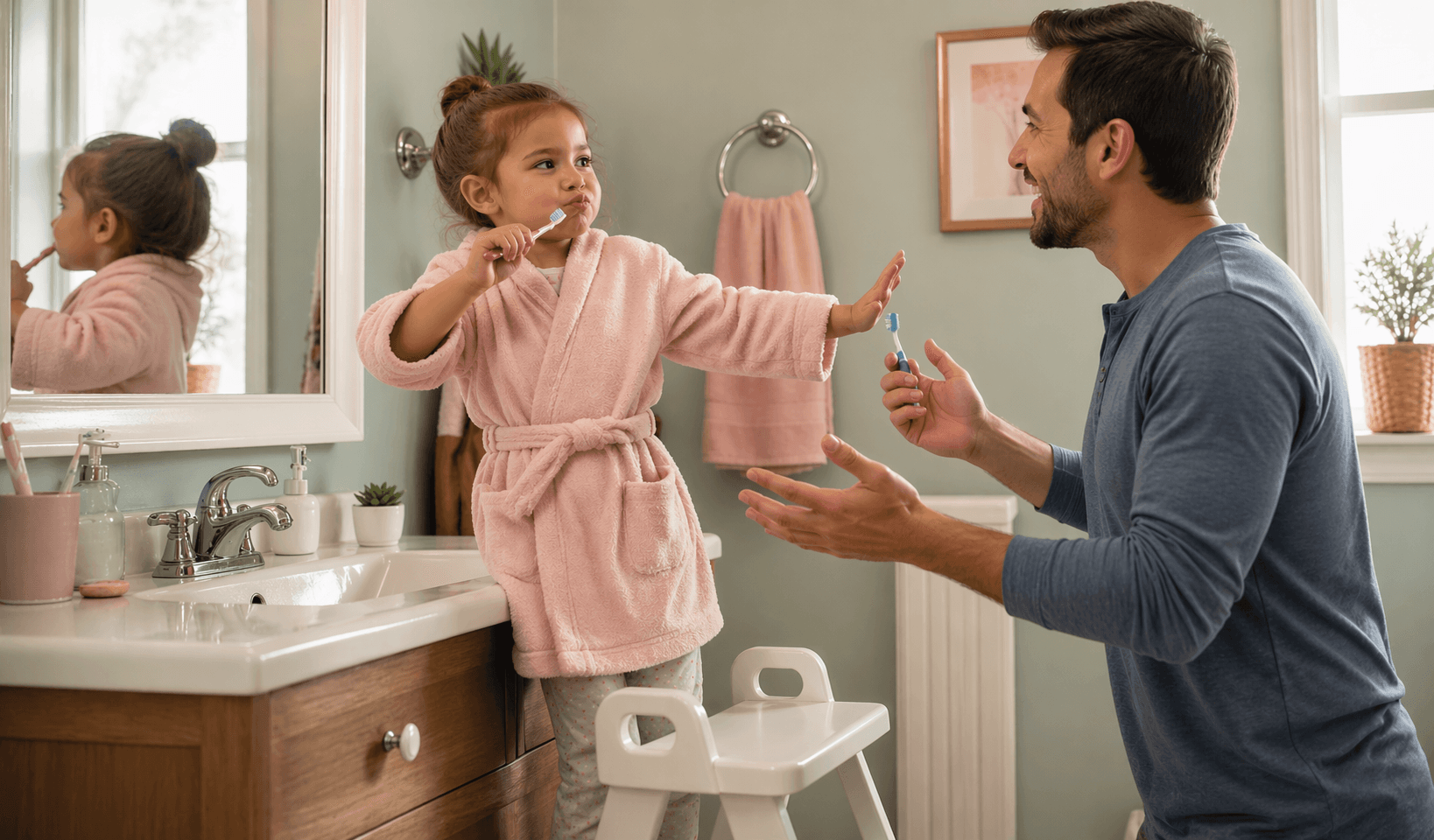
If your kid wants to brush alone, that is actually a good sign. It usually means your child is growing in confidence, wants more independence, and feels proud of doing things without help.
The tricky part is that confidence and brushing skill do not develop at the same speed.
A child may truly want to do it themselves and still miss the back teeth, rush through the job, or glide over the gumline in ten seconds. That leaves many parents stuck between two worries: respecting independence and protecting their child’s teeth.
The good news is you do not have to choose one or the other.
A gentle middle-ground approach often works best: you brush, then I finish or you start, I help check. That gives your child ownership while still protecting their smile.
In this article, we’ll look at when kids can brush independently, why so many young children still need help brushing, and simple ways to finish brushing without turning it into a nightly fight.
Why kids want to brush alone
Children between about ages 3 and 6 are in a strong independence stage. “I do it myself” is not just a phrase. It is part of how they learn confidence and control.
That is why brushing can become a power struggle. Your child is not necessarily refusing help because they dislike brushing. Often, they are trying to protect their sense of ownership.
If you respond only with correction, the routine can quickly become a battle. But if you respect the independence need while keeping the brushing standard, the whole interaction usually goes more smoothly.
Why do kids miss so many spots
Even when children are motivated, brushing well takes more skill than it looks.
To clean teeth properly, a child has to:
• hold the brush at the right angle
• reach the back teeth
• move slowly enough to clean each area
• notice the gumline and chewing surfaces
• spit out toothpaste and keep going long enough
That is a lot for little hands and still-developing coordination.
Pediatric oral-health guidance notes that many children still need help with brushing until around age 7 or 8, because the dexterity needed for thorough brushing is still developing.
So if you are wondering whether you still need to help brushing a 6-year-old, the answer is very often yes.
When can kids brush independently?
Parents often search: when can kids brush independently? The most honest answer is: it depends on skill, not just age.
Many children are not ready to brush thoroughly on their own until around age 7 or 8, and some need supervision even longer. A helpful rule of thumb shared by pediatricians is that when a child can tie their own shoelaces well, their hand coordination is usually getting close to what they need for brushing. Even then, supervision still matters.
That means independence can happen in stages:
• first, your child participates
• then, your child starts brushing while you help finish
• later, your child brushes more thoroughly while you supervise and check
• eventually, your child brushes independently with occasional spot-checks
This staged approach protects both the relationship and the routine.
One of the most parent-friendly strategies is the simple routine: you brush, then I finish.
Why it works:
• your child gets a real turn first
• you protect against missed spots
• it feels less controlling than taking over from the start
• it helps brushing become a shared skill, not a test
You can say something like:
“You did a great job brushing. Now let me help catch the invisible plaque monsters - the ones that don’t show up in the mirror.”
That line works because it protects your child’s pride while permitting you to help.
How to make finishing brushing feel better, not bossy
If your kid wants to brush alone, the goal is to help without making them feel like they failed.
Here are a few ways to do that:
1. Call it a team-up, not a correction
Instead of saying, “You missed spots,” try:
• “Now it’s my helper’s turn.”
• “Let me do the final sparkle check.”
• “I’m going to help with the tricky back teeth.”
That small language shift reduces shame and keeps the mood calm.
2. Let your child choose the check-in method
Children often accept help more easily when they get some control over how it happens.
Try offering choices like:
• “Do you want me to check the top teeth first or the bottom teeth first?”
• “Mirror check or lap check?”
• “Do you want your turn first, or should I start and you finish?”
These choices do not remove the boundary. They make the finish feel more collaborative.
3. Use a ‘special jobs’ system
Let your child own some parts of brushing and let you own the harder parts.
For example:
• your child brushes the front teeth
• you do the back teeth and gumline
• your child gets the chewing surfaces
• you do a final sweep
This helps a child feel capable while also making room for real parental help.
4. Turn finishing into a mission
You can frame the parent-help part as something advanced and important.
Examples:
• “I’m on back-tooth patrol.”
• “Time for the hidden-corner check.”
• “Let’s see if any plaque monsters are hiding behind the molars.”
Children often accept help more easily when it sounds like part of the game, not the end of their independence.
5. Use plaque-disclosing tablets once in a while
Disclosing tablets can be a fun visual check-in for older preschoolers and school-age kids when used appropriately and with your dentist’s guidance. They can turn missed spots into a simple mission instead of a lecture.
Try saying:
“Let’s hunt for the missed spots.”
Because the color shows plaque visually, it takes some of the conflict out of the conversation. Instead of arguing, you and your child can look together.
2 more ideas to help finish brushing while keeping independence
1. Let your child teach you the routine
Children often cooperate better when they get to feel knowledgeable.
Try this: let your child explain where you should brush next. You still do the brushing finish, but your child becomes the ‘coach.’
For example:
• “Should I check the back teeth now, Coach?”
• “Which side needs the final sparkle?”
This keeps your child engaged and gives them a leadership role.
2. Use a short timer for ‘their turn’ and ‘your turn’
A timer helps make the routine feel fair.
You can say:
• “You get the first minute. I get the second minute.”
• “Your turn, then helper turn.”
The timer makes the handoff predictable, which lowers resistance.
What if my child gets upset when I try to help?
That is common, especially if brushing has already become emotionally loaded.
If your child protests when you finish brushing:
• stay calm and use fewer words
• validate feelings without giving up the routine
• keep the boundary predictable
• avoid turning missed spots into criticism
You might say:
“You really wanted to do it all by yourself. I hear that. I’m still going to help with the tricky parts so your teeth stay healthy.”
This approach respects feelings without giving up your job as a parent.
A note on cavity prevention and real dental care
Helping your child finish brushing is not about perfectionism. It is about preventing plaque from sitting on teeth day after day.
Professional pediatric recommendations support brushing twice a day with fluoride toothpaste, using only a smear or rice-sized amount for children under 3 and a pea-sized amount for ages 3 to 6. A soft-bristled, child-sized toothbrush is recommended, and parental help or supervision remains important while dexterity is still developing.
That is why helping until about age 7 or 8 is so often recommended. Dental hygiene is not just about fresh breath. It helps lower the risk of tooth decay, supports healthy gums, and protects overall oral health while children are still learning the skill.
A gentler path through the independence stage
If your child wants to brush alone, that independence is something to encourage - just with support around it.
You do not have to choose between confidence and clean teeth.
With a calm routine, respectful language, and a simple shared-brushing plan, you can protect your child’s smile without making brushing feel like a fight.
At Brave Tooth Alliance, we believe healthy habits grow best when children feel capable, encouraged, and understood. A little teamwork can go a long way - especially when those back teeth still need a grown-up finish.
If you want extra help, explore our story-driven resources and printable brushing tools for gentle ways to make daily dental care easier at home.